Back to books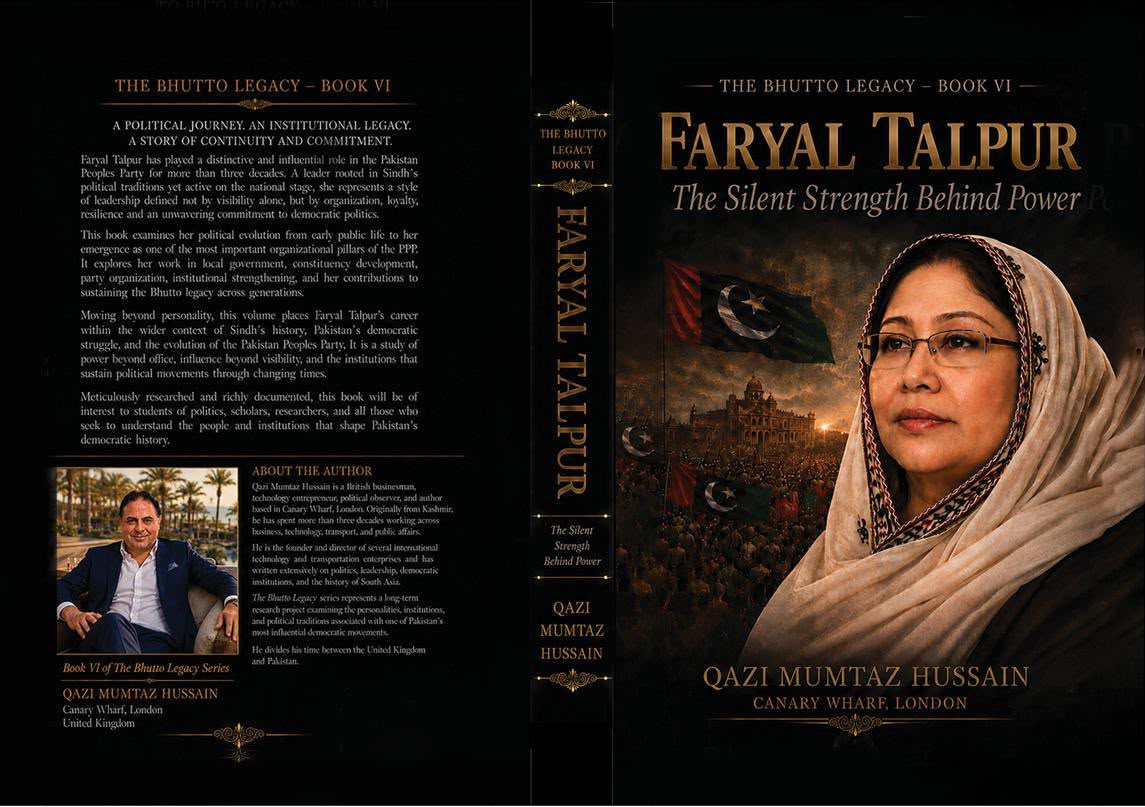
Ultimately, the book argues that political endurance is not only the product of charismatic leadership, but also of quieter, sustained efforts that preserve institutional function across generations. It offers readers an in-depth understanding of how power is maintained, transferred, and stabilized within one of Pakistan's most influential political organizations.nce and the foundations that sustain public legacies.
Faryal Talpur: The Silent Strength Behind Power
Qazi Mumtaz HussainEnglishHardcover / Paperback
This volume, The Bhutto Legacy - Book VI: Faryal Talpur - The Silent Strength Behind Power, is a detailed political biography and institutional analysis of Faryal Talpur within the broader evolution of Pakistan's contemporary political landscape.
The book examines her role not as a headline-driven political figure, but as a structural and organizational actor within one of South Asia's most enduring political movements, the Pakistan Peoples Party. It explores how political influence operates beyond visibility, focusing on continuity, institutional memory, and the mechanics of party organization across shifting political environments.
Set against the backdrop of Sindh's historical and political landscape, the narrative traces the formative influences that shaped her political development, including family networks, regional political culture, and early exposure to governance structures. It situates her emergence within a wider tradition of political families in Pakistan, particularly the interconnected legacy of the Bhutto and Zardari political lineage.
A significant portion of the analysis focuses on the post-2007 transformation of Pakistani politics following the assassination of Benazir Bhutto. The resulting institutional transition within the PPP under the leadership of Asif Ali Zardari is examined in relation to organizational survival, party cohesion, and the role of internal actors in maintaining stability during political uncertainty.
The book further explores the concept of Bhuttoism as a political tradition rather than a fixed ideology, highlighting its evolution across decades of democratic struggle, electoral politics, and institutional adaptation. Within this framework, Faryal Talpur's contribution is positioned as one of continuity rather than spectacle, emphasizing administrative coordination, constituency engagement, and organizational resilience.
Drawing on historical records, political scholarship, parliamentary documentation, and publicly available sources, this work provides a structured analysis of how political systems survive through networks, institutions, and long-term relationships. It also examines the intersection of gender, leadership, and political authority in South Asian democratic contexts.